
Decoding Insertion Loss and Return Loss: A Technical Spec Guide for MPO/MTP Cabling
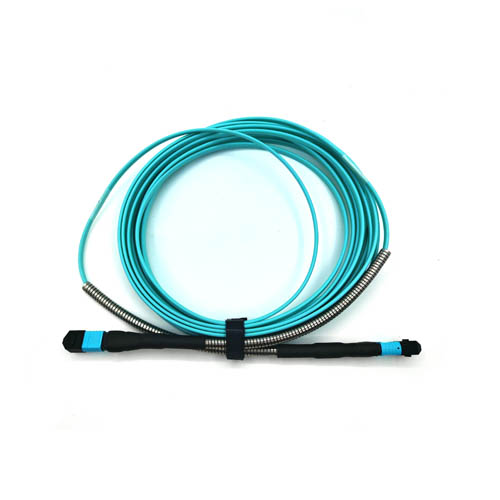
High-density MPO/MTP patch cables are specified by two performance numbers: insertion loss and return loss.
Insertion loss and return loss are the two specifications that decide whether an MPO/MTP cabling run stays inside its optical budget, not only on installation day but across the life of the network. Insertion loss (IL) measures how much light is lost at a mated connector pair; return loss (RL) measures how much light is reflected back toward the source. For engineers specifying MPO/MTP patch cords, trunk cables, and breakout assemblies, these two values translate directly into link margin, upgrade headroom, and long-term supply consistency.
This guide explains what each parameter measures, how standard and Elite grade targets differ (a 0.5 dB versus a 0.35 dB insertion loss limit; a 50 dB UPC versus a 60 dB APC return loss floor), and how to verify that a supplier can hold those numbers order after order. It is written for the engineers and procurement teams who treat a patch cord as infrastructure rather than as a consumable.
The Problem: A Datasheet Number Without a Link Budget
A datasheet that reads 'insertion loss 0.5 dB' tells a buyer very little on its own. What matters is how that number behaves inside a real channel. Every mated pair in a channel adds its own loss, and a high-density MPO/MTP path typically contains several: an MPO trunk cable, one or more breakout assemblies, and the adapter interfaces between them. When a link uses multiple mated pairs, the difference between standard and Elite grade accumulates into a meaningful share of the total optical budget.
The second problem is drift. Insertion loss is not a fixed property of a product line; it is a process outcome. Multi-core alignment error, insertion loss drift, and crosstalk at high-speed transmission are recognised failure modes in multi-fiber connectors. Each of them is controlled at the manufacturing stage, through precision polishing, active alignment technology, and crosstalk suppression design, rather than detected after deployment. A supplier that tests only a sample can ship a batch whose real-world distribution of loss is wider than the datasheet implies.
The third problem is that budget pressure tends to convert a technical decision into a price decision. Two suppliers can quote the same connector type at noticeably different prices while both claiming the same grade. Without a defined verification regime, the buyer has no way to tell whether the difference reflects process capability or simply a looser interpretation of the same datasheet limit.
The core issue: insertion loss and return loss are specified as limits, but they are delivered as a distribution. The engineering question is not 'what is the maximum?' but 'how tightly can the supplier hold the population?'
Industry Background: Why These Specs Now Decide Data Center Builds
Multi-fiber connectivity has moved from a niche option to a default for high-density builds. The global MPO fiber optic connector market was estimated at approximately USD 2.1 billion in 2024 and is projected to grow to USD 3.2 billion by 2030. Asia-Pacific is the largest regional market, accounting for approximately 42% of global share in 2024, followed by North America.
The product mix is equally telling. Multimode MPO connectors hold over 88% of the market share, driven by short-range data center interconnects, while hyperscale data centers integrated MPO connectors in over 70% of their facilities globally in 2024 to support parallel optics and high-density cabling. In other words, the majority of large-scale deployments now depend on multi-fiber connectors whose performance is governed by IL and RL.
Interoperability across that ecosystem rests on standards rather than on brand. MPO connectors are defined by international standards IEC 61754-7 and TIA-604-5 (FOCIS 5), which ensure intermateability across different manufacturers. The MTP connector, a registered trademark of US Conec, is an enhanced MPO version featuring a floating ferrule and elliptical guide pins for improved optical performance. Because these interfaces can be mated across vendors, the only thing standing between a clean link and an inconsistent one is how closely each party holds its own optical limits.
Beyond the data center, the same multi-fiber interfaces extend into outdoor and FTTA deployments, where assemblies must survive temperature cycling, moisture, and mechanical load while still holding their optical limits. A connector that meets its insertion loss target on the bench but drifts after thermal cycling does not preserve a link budget in the field. For that reason, long-term buyers increasingly evaluate optical performance and environmental durability as a single specification package rather than as two separate purchases.
What Insertion Loss Actually Measures
Insertion loss is the light energy lost when two connectors are mated. In a multi-fiber connector it is the sum of several effects: lateral and angular misalignment between the fiber cores, end-face geometry and polish quality, and the cleanliness of the interface. Because it is measured per mated pair, it is a directly additive quantity in a link budget.
This is why grade selection is a budget decision rather than a marketing one. The following targets are the ones engineers most commonly specify:
| Insertion loss grade | Typical target | Where it is usually specified |
|---|---|---|
| Elite grade | 0.35 dB or lower | 400G and long-reach paths, tight-budget links, paths with many mated pairs |
| Standard grade | 0.5 dB or lower | General high-density patching where budget headroom is comfortable |
The numerical difference between the two rows looks small, but it is applied at every mated pair. In a channel that uses several MPO interfaces, standard grade can consume budget that Elite grade preserves. That preserved margin is what later allows a link to be upgraded or re-routed without re-cabling, which is why the choice is better made once, at the specification stage, than revisited during a capacity expansion.
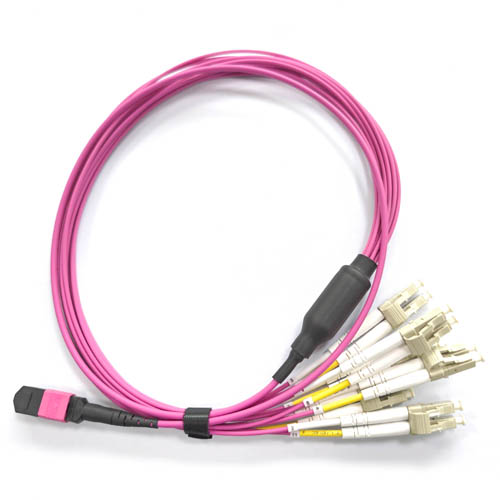
A 12-fiber MPO patch cord: insertion loss is measured per mated pair and accumulates across the channel.
What Return Loss Actually Measures
Return loss is the ratio of reflected light to incident light at the connector interface, expressed in decibels. A higher return loss figure means less reflection, which is the desirable direction. Reflections are worsened by air gaps, mismatched end-face geometry, and poor polish quality, and they matter more as per-lane data rates rise, because reflected energy degrades the signal-to-noise margin at the receiver.
Return loss is governed primarily by the end-face polish geometry, which is why the specification is written by polish type rather than by grade:
| End-face polish | Typical return loss target | Notes |
|---|---|---|
| APC (angled physical contact) | 60 dB or higher | Angled end face directs reflections away from the core |
| UPC (ultra physical contact) | 50 dB or higher | Common in multimode, short-reach patching |
The practical rule for specifiers is that insertion loss and return loss should never be evaluated in isolation. A connector can meet its IL target and still produce unacceptable reflection if the polish geometry is inconsistent. Both values have to be verified together, per connector, and recorded so that a later batch can be compared against the original acceptance data.
Standard vs Elite Grade: Translating Decibels into Decisions
Grade selection follows a simple decision rule. If the link budget has comfortable headroom, standard grade (0.5 dB or lower) is usually sufficient. If the channel contains many mated pairs, is intended to support higher per-lane speeds, or must remain upgradable over a multi-year lifecycle, Elite grade (0.35 dB or lower) protects margin that would otherwise be spent at installation.
A useful way to decide is to count the mated pairs in the worst-case channel and multiply the grade delta across them. Where that total is a small fraction of the available margin, standard grade is a rational choice. Where it approaches the margin the design actually needs, the Elite premium is effectively an insurance cost against future re-work, re-termination, and lost capacity.
For procurement teams, the more important question is how the grade is proven. A grade claim is only as good as the testing behind it. Multi-core alignment error and insertion loss drift are process-driven risks, and they are controlled through precision polishing, active alignment technology, and crosstalk suppression, backed by testing that covers the full production population rather than a sample.
Verification standard to ask for: 100% insertion loss testing, automated alignment inspection, and high-speed signal integrity validation. A supplier able to run all three can defend a grade claim across repeat orders; one that tests samples cannot.
A Step-by-Step Method for Verifying MPO/MTP Specs Before You Commit
Specification review should follow a fixed sequence. The steps below are written for buyers who need the same performance in month twelve that they received in month one.
- Set the grade against the link budget. Decide whether the channel requires Elite grade (0.35 dB or lower) or standard grade (0.5 dB or lower), and state the return loss floor by polish type (60 dB or higher for APC, 50 dB or higher for UPC). Fixing these before quotation keeps comparisons like-for-like.
- Request connector-level test data, not a catalogue clip. Ask for the test method and the sampling regime. A datasheet limit is a claim; a test report is evidence, and the two should be archived together for the life of the supply relationship.
- Confirm the testing regime is 100%, not sampled. For multi-fiber connectors, sample-based testing leaves the tail of the distribution unmeasured. A 100% insertion loss testing process, supported by automated alignment inspection, is what makes a grade limit meaningful at batch level.
- Check the alignment and polish process. Multi-core alignment error and crosstalk are designed out, not inspected in. Ask how active alignment technology and crosstalk suppression design are applied on the production line, and how that is monitored over time.
- Validate signal integrity, not just static loss. High-speed signal integrity validation confirms that measured low loss translates into usable performance at the intended data rate, which is the outcome the link budget was written for.
- Write the spec into the supply agreement. For long-term programs, the acceptance criteria matter as much as the initial sample: pre-shipment testing, third-party inspection, and factory acceptance testing should all be defined in advance.
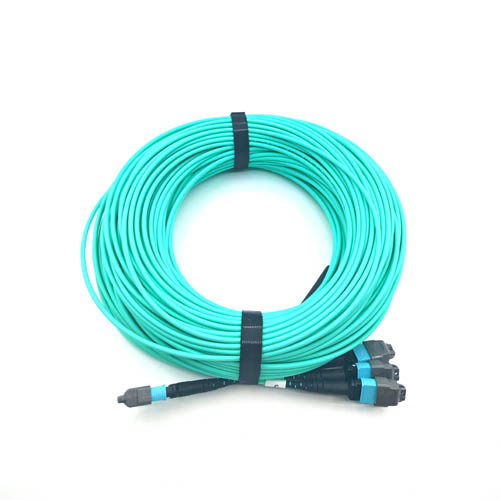
MPO trunk and breakout assemblies: each interface in the channel adds its own insertion loss.
Where Insertion Loss and Return Loss Decide Outcomes
Three deployment patterns account for most MPO/MTP specification decisions.
400G data center backbone
Parallel-optics backbone links use multi-fiber trunks between switch ports and patching fields. Because these channels carry several mated pairs, Elite grade insertion loss preserves the margin needed for reliable operation and later re-configuration. Return loss matters here because reflection reduces receiver margin at high per-lane rates.
Breakout and fan-out to LC
Breakout assemblies convert a multi-fiber trunk into duplex LC paths at the equipment. Each breakout adds its own mated interface, so loss accumulates at exactly the point where troubleshooting is hardest. Specifying and verifying low-loss connectors on both the trunk and the breakout keeps the channel predictable when a fault has to be located.
Multimode short-reach patching
Multimode MPO connectors dominate the market, holding over 88% of share, because short-reach data center interconnects rely on them. In these runs, UPC polish with a 50 dB or higher return loss target is common, while insertion loss discipline remains the primary driver of link margin.
MPO/MTP vs Traditional LC/SC: Relevant Spec Comparison
When a project is weighing multi-fiber connectivity against traditional duplex patching, the comparison that matters is not connector size alone but the density, loss, and total-cost profile over the life of the installation.
| Dimension | MPO/MTP multi-fiber | Traditional single-core LC/SC |
|---|---|---|
| Core integration | High-density multi-core integration | Single-core, one fiber per connector |
| Speed support | 40G / 100G / 400G high-speed support | Duplex patching per port |
| Insertion loss | Low insertion loss, 0.2 dB lower | Higher aggregate loss at equal port count |
| Port density | 8–24x higher port density | Baseline density |
| Deployment speed | 60% faster deployment | Baseline deployment effort |
| Best fit | Next-gen data center high-density cabling, server–switch interconnection, 400G backbone networks | Low-count, legacy, or single-port patching |
| Upfront cost | 15–20% higher upfront cost | Lower upfront cost |
| Total cost of ownership | 30% lower TCO through reduced cable and labour costs | Baseline TCO |
| Maintenance profile | 50% fewer failure points, under 5 minutes for modular replacement, simplified cable management | More individual patching points to manage |
| Efficiency | 15% lower transmission loss, 70% less rack space, reduced cooling energy | Baseline footprint and cooling load |
The table is not an argument that multi-fiber replaces duplex patching everywhere. It shows why MPO/MTP is chosen for high-density work, and why the insertion loss and return loss discipline behind those connectors carries more weight than connector count alone.
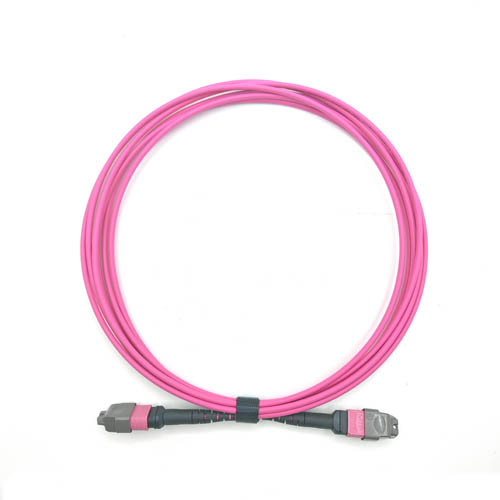
MPO multimode patch cords dominate short-reach data center interconnects, where insertion loss drives link margin.
Long-Term Supply: Why Spec Consistency Is an Ecosystem Question
For programs built and expanded over several years, insertion loss and return loss become a supply-chain property rather than a single-purchase one. A network assembled from connectors held to a consistent grade behaves predictably as it grows; a network where each batch drifts behaves unpredictably, and the cost of that drift appears later as troubleshooting, re-termination, and lost margin.
This is where manufacturing discipline and long-term partnership converge. FOCC Fiber Co., Ltd, located in Shenzhen, Guangdong, is a professional supplier of fiber optic connectors, MTP/MPO fiber optic patch cords, and outdoor waterproof armored patch cord assemblies. Its Guangzhou factory covers 5,000 square meters and focuses on precision manufacturing, with stated advantages in high-density integration, high-reliability connections, and outdoor protection.
The company was founded in 2014, operates with 200 employees and a 30-person R&D team, and produces an annual output of 2,000,000 units. It strictly implements ISO9001 and ISO14001 management systems, and its products are exported to more than 30 countries and regions, with main markets in the EU and USA. Partner clients listed by the company include Prysmian, Siemens, Coherent, Fujikura, and NTT. For buyers evaluating a multi-year supply base, the relevant long-term signal is over ten years of professional ODM/OEM service experience: consistent optical specs are a process capability, and process capability is what repeat orders depend on.
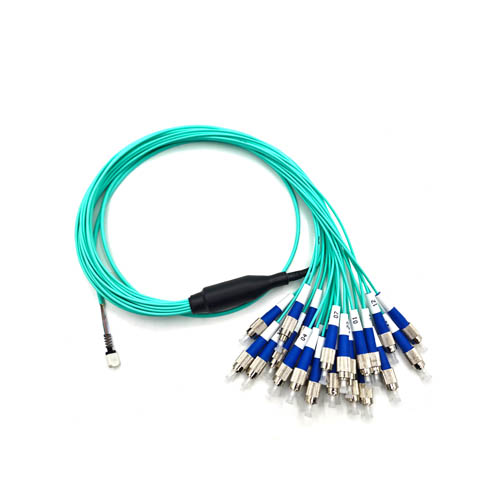
Breakout assemblies add interfaces, and insertion loss, so component-level spec control matters most in the longest channels.
Frequently Asked Questions
1. Which standards define MPO connector intermateability, and how do they affect spec acceptance?
MPO connectors are defined by international standards IEC 61754-7 and TIA-604-5 (FOCIS 5), which ensure intermateability across different manufacturers. At acceptance, this means the connector interface itself is standardised, so the buying decision rests on the optical limits a supplier commits to, namely insertion loss and return loss, rather than on proprietary geometry.
2. Can a manufacturer actually guarantee a 0.35 dB insertion loss limit on every connector?
A grade claim can only be defended if it is tested across the full production population rather than a sample. The relevant controls for multi-core alignment error, insertion loss drift, and crosstalk are precision polishing, active alignment technology, and crosstalk suppression design. FOCC Fiber applies 100% insertion loss testing, automated alignment inspection, and high-speed signal integrity validation, the combination that makes an Elite-grade limit verifiable rather than nominal.
3. How does specifying Elite grade affect budget?
Compared with traditional single-core LC/SC patching, MPO/MTP assemblies carry a 15–20% higher upfront cost but deliver an estimated 30% lower total cost of ownership through reduced cable and labour costs. Within MPO/MTP itself, Elite grade is specified where link budget is tight: it protects margin that a standard-grade build would spend at installation. The trade-off is straightforward, pay a little more per connector now or lose upgrade headroom later.
4. What does the acceptance and sample process look like?
Purchasing terms include a minimum order quantity of 2 units, with EXW or FOB delivery terms. Acceptance criteria are built around verification rather than assumption: 100% pre-shipment test, support for third-party inspection, factory acceptance test (FAT), and on-site acceptance, with T/T payment terms. Buyers typically request a sample MPO/MTP patch cord together with its test report before locking a specification into a larger order.
5. What are the lead-time and ordering considerations for a long-term supply program?
For recurring programs, the practical path is to fix the grade and return loss targets first, then agree on the acceptance regime, including pre-shipment testing, third-party inspection, FAT, and on-site acceptance, before volume orders begin. A minimum order quantity of 2 units supports sample-stage validation, and EXW or FOB terms let buyers plan logistics around their own schedule. FOCC Fiber Co., Ltd accepts T/T payment and can be reached at sales@mefiberoptic.com or via WhatsApp at +86 13823237984 for specification questions and sample requests.
Ready to verify the numbers on paper against a real sample?
Request an MPO/MTP patch cord sample with its insertion loss and return loss test report, and compare the results against your link budget before you commit to a specification. Visit www.focc-fiber.com or email sales@mefiberoptic.com.

FOCC Fiber Co., Ltd, a Shenzhen-based supplier of MTP/MPO patch cords, outdoor waterproof assemblies, and armored patch cords.
Conclusion
Insertion loss and return loss are the two specifications that convert an MPO/MTP purchase into a predictable link. Insertion loss (0.35 dB Elite, 0.5 dB standard) accumulates per mated pair and must be read against the total channel budget. Return loss (60 dB APC, 50 dB UPC) is set by polish geometry and protects receiver margin at high per-lane rates.
Both numbers are only as reliable as the process behind them. Precision polishing, active alignment technology, and crosstalk suppression control the risks; 100% insertion loss testing, automated alignment inspection, and high-speed signal integrity validation prove the control. For engineers and procurement teams building for the long term, that combination, not the datasheet limit alone, is what makes a specification safe to standardise on.
Have Questions or Need More Details?
Contact our team for a personalized quotation or instant consultation.
Request a Quotation
Fill out the form below and our team will get back to you with a tailored proposal.
WhatsApp Direct Chat
Prefer to chat in real-time? Message us on WhatsApp for instant assistance & quick answers.
- Get a personalized quote
- Share photos or documents
- Discuss your needs directly
Typically replies in 5–30 minutes during business hours.