
Decoding Multi-Fiber Certifications: The Compliance Guide for MPO/MTP in Global Data Centers
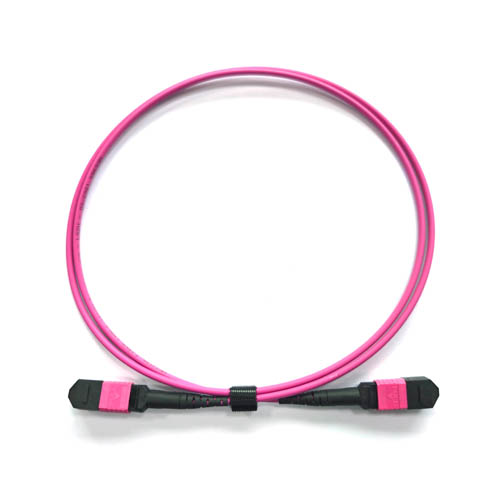
MPO/MTP certification in a data center procurement context is a two-layer requirement, not a single badge. The first layer is a management-system certification — ISO 9001 and ISO 14001 — that must be traceable to a certificate number, an issuing body, an accreditation standard and a defined scope of production. The second layer is product-level compliance: the multi-fiber assembly must be manufactured and tested against recognized connector standards, with Telcordia GR-326 as the reliability and performance reference, and IEC 61754-7 and TIA-604-5 (FOCIS 5) defining the MPO interface that makes assemblies from different manufacturers mateable.
This guide is written for procurement managers, network engineers and data center operators who have moved past supplier discovery and are now evaluating whether a supplier's compliance claims will hold up in a tender document, a supplier audit or a field failure investigation. It explains what each certification layer actually covers, how measurable specifications — insertion loss, return loss and RoHS status — connect to those claims, and how to verify the whole package in six practical steps.
Why "MPO Compliant" Is Not the Same as Certified
MPO connectors are defined by the international standards IEC 61754-7 and TIA-604-5 (FOCIS 5), which ensure intermateability across different manufacturers. That definition guarantees the interface will physically mate. It does not guarantee that a specific patch cord was built, polished and tested under a repeatable process, and it says nothing about whether the supplier's quality system has been independently audited. Treating the interface standard as proof of supplier compliance is the most common gap in high-density cabling procurement.
In practice, buyers evaluating MPO/MTP patch cords at the Evaluation stage run into three recurring problems:
- Datasheet-only compliance. A supplier quotes insertion loss figures but cannot point to a certificate number, an issuing body or a scope statement behind them.
- Certificate without scope fit. An ISO certificate exists, but its stated scope may not cover fiber optic patch cable production and sales — which matters when a buyer's compliance team checks the wording rather than the logo.
- Standard cited, evidence missing. A standard is named in the quotation, but there is no per-assembly test record behind it, so there is nothing to trace when a link underperforms after commissioning.
For a network running 400G spine-leaf interconnection across hundreds of cabinets, these gaps are not administrative details. They surface later as intermittent link errors, re-polishing work inside live racks, or replacement shipments landing in the middle of an installation schedule — precisely the outcomes that certification documentation is designed to prevent.
The Standards Landscape Behind Multi-Fiber Connectors
Multi-fiber connectivity has moved from a specialist choice to a default architecture in high-density environments. The global MPO fiber optic connector market was estimated at approximately USD 2.1 billion in 2024 and is projected to grow to USD 3.2 billion by 2030 (Strategic Market Research). In 2024, hyperscale data centers integrated MPO connectors in over 70% of their facilities globally to support parallel optics and high-density cabling (SkyQuest Technology). Multimode MPO connectors dominate the product segment with more than 88% of market share, driven by short-range data center interconnects (Valuates Reports), and Asia-Pacific accounted for approximately 42% of the global MPO connector market in the same period (Valuates Reports).
As volumes scale, so does the cost of an unverified claim. A certificate that cannot be resolved into a scope, a test regime and a measurable specification is effectively an unmanaged risk carried by the buyer. This is why compliance documentation has shifted from a final paperwork step to an early shortlisting filter in data center and telecom procurement.
Four compliance layers buyers should be able to name
- Management system: ISO 9001 and ISO 14001, evidencing controlled quality and environmental processes.
- Connector and assembly reliability: Telcordia GR-326, the performance and reliability reference applied to fiber optic connectors and jumper assemblies.
- Interface intermateability: IEC 61754-7 and TIA-604-5 (FOCIS 5), defining the MPO interface dimensions.
- Material restrictions: RoHS compliance for the materials used in the assembly.
MTP is a brand, not a separate standard
The MTP connector is a registered trademark of US Conec and is an enhanced MPO version featuring a floating ferrule and elliptical guide pins for improved optical performance (US Conec). The practical consequence for specification writing is straightforward: MTP and MPO assemblies are evaluated against the same international interface and performance standards. The differences sit in connector design and manufacturing execution, not in a separate certification regime. Buyers who draft tender language as though "MTP" were an alternative standard create ambiguity that suppliers can interpret in different ways.
How FOCC Fiber Documents MPO/MTP Compliance
FOCC Fiber Co., Ltd is a Shenzhen-based manufacturer of fiber optic connectors, MTP/MPO fiber optic patch cords, outdoor waterproof patch cord assemblies and armored patch cords, supplying New Generation Data Centre and FTTA solutions. Its Guangzhou factory covers 5,000 square meters and is focused on precision manufacturing, with development emphasis on high-density integration, high-reliability connections and outdoor protection. The company exports 100% of its output, primarily to the EU and USA markets, and has supplied ODM/OEM programs for more than ten years.
Layer 1: ISO certification HIC230831 and management systems
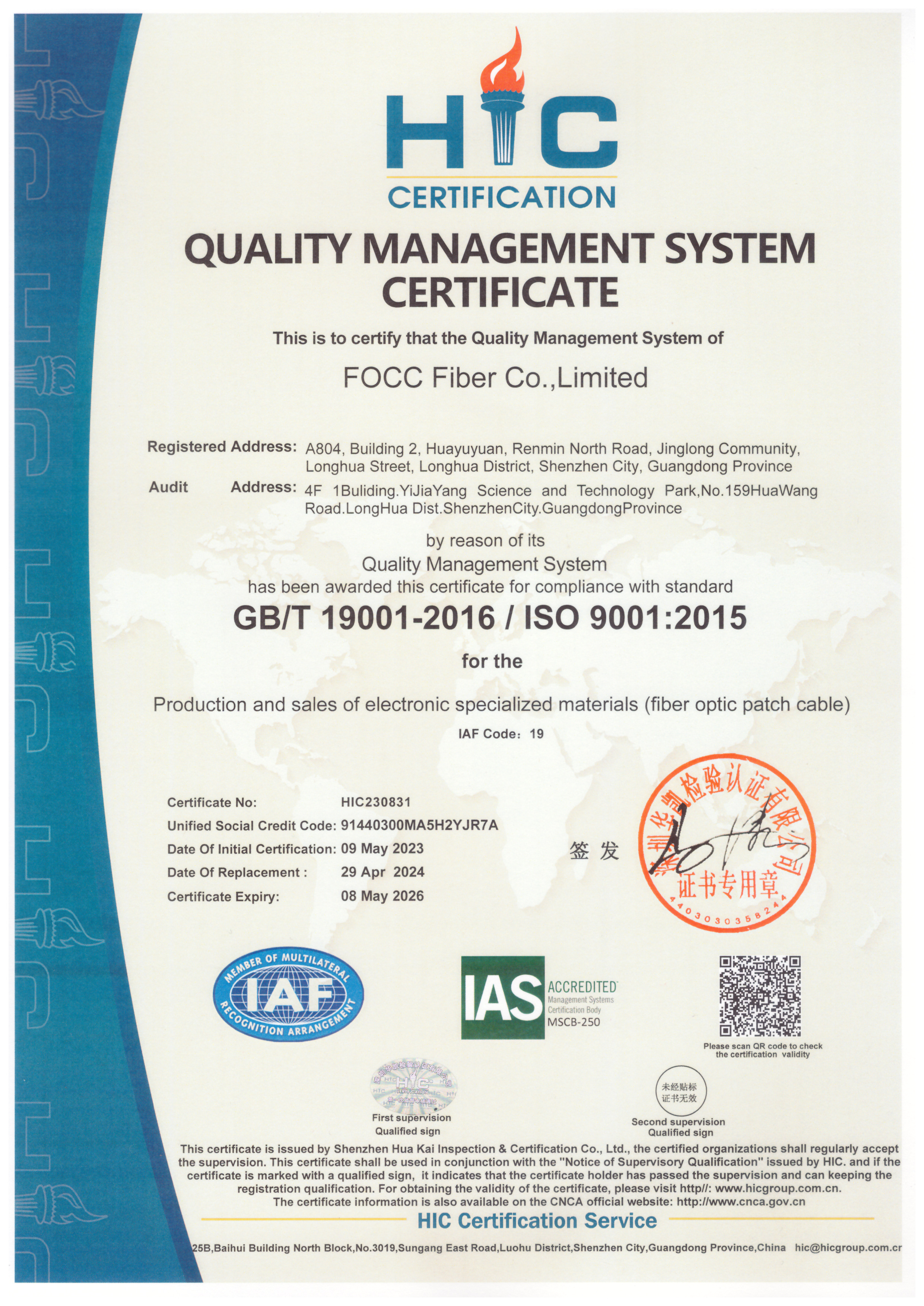
FOCC holds ISO certification HIC230831, issued by HIC under the IAF/IAS standard, with a scope of "Production and sales of electronic specialized materials (fiber optic patch cable)" and worldwide market coverage. The company also strictly implements ISO 9001 and ISO 14001 management systems. For a buyer, the value of this is traceability rather than symbolism: there is a certificate number to verify, a named issuing authority, an accreditation reference, and a scope wording that explicitly names fiber optic patch cable production and sales. Those are the four data points a compliance reviewer will ask for, and they can be checked instead of assumed.
Layer 2: Telcordia GR-326 compliance
FOCC states that its MPO/MTP patch cords are compliant with Telcordia GR-326. This is the layer where certification stops being a document and becomes an engineering claim, because GR-326 addresses the performance and reliability of fiber optic connectors and jumper assemblies. In a procurement conversation, the practical translation is that the supplier should be able to support the declaration with measurable data: insertion loss, return loss and end-face quality evidence produced during production, not only at design stage.
Layer 3: Specifications that connect to the standard
The following specification anchors are the ones FOCC applies to its MPO/MTP patch cords and the ones procurement teams should request in writing before awarding a purchase order:
- Insertion loss: controlled to ≤0.35 dB in high-grade assemblies, with ≤0.5 dB as the accepted specification limit.
- Return loss: ≥60 dB on APC-polished interfaces, which matters in reflectance-sensitive high-speed links.
- RoHS: RoHS-compliant materials, supporting access to EU and other regulated markets.
- Testing: 100% factory testing of finished assemblies, not batch sampling.
- Alignment: precision active alignment in production to support connector repeatability.
Layer 4: Manufacturing facts that make the claim sustainable
Compliance claims are only credible if the production system behind them can hold tolerances at volume. FOCC's operating profile includes a 5,000 square meter factory in Guangzhou, approximately 200 employees, a 30-person R&D team, an annual output of 2,000,000 units and a monthly capacity of 200,000 units. The company operates an OEM/ODM production model with customization across length, connector type, core count, transmission mode, material, logo printing, certification and packaging. Minimum order quantity is 2 units, standard lead time is 3–15 days, and after-sales support is delivered remotely. These figures matter to evaluators because they indicate whether a supplier can repeat a verified process across a multi-cabinet rollout rather than across a single sample.
A Six-Step Compliance Verification Workflow
The workflow below is designed to be run before a purchase order is issued, and it can be completed with documents and samples rather than with site visits.
Step 1 — Define the standard set before discussing price
Write the applicable standards into the requirement itself: IEC 61754-7 and TIA-604-5 (FOCIS 5) for the MPO interface, Telcordia GR-326 as the connector and jumper assembly reliability reference, ISO 9001/ISO 14001 at the management-system level, and RoHS for material compliance. Establishing this list first prevents the conversation from collapsing into a unit-price comparison between assemblies that are not built to the same requirement.
Step 2 — Verify the certificate properly, not just its existence
Confirm the certificate number, the issuing body, the accreditation standard and the scope wording. For FOCC, that means ISO certificate HIC230831, issued by HIC under IAF/IAS, with a scope naming production and sales of electronic specialized materials (fiber optic patch cable). A certificate whose scope does not name the product family being purchased should trigger a follow-up question, not a signature.
Step 3 — Convert the certification claim into measurable specifications
Ask for insertion loss as both a typical value and a specification limit, return loss by polish type, and a RoHS statement. A GR-326 compliance claim without these numbers is a statement of intent; with them, it becomes a checkable requirement that can be confirmed against incoming inspection or a sample test report.
Step 4 — Ask for test evidence, not test promises
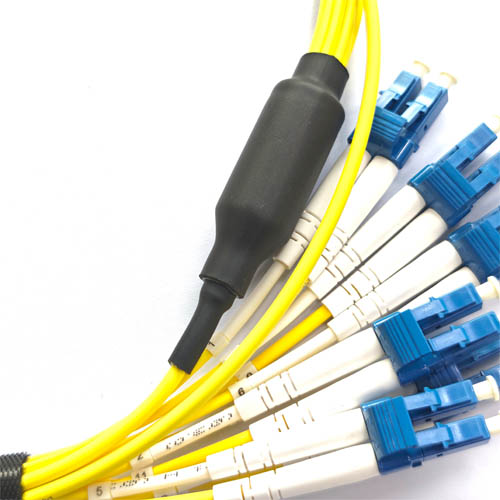
The difference between batch testing and 100% testing is the difference between a statistical claim and a per-assembly record. FOCC tests 100% of finished assemblies, which means a specific patch cord shipped to a specific cabinet can be traced back to a test step rather than to a batch average. When a link underperforms, that traceability shortens the investigation considerably.
Step 5 — Validate the capacity and continuity behind the certificate
A compliant sample from a supplier that cannot repeat the process at volume still exposes the project to risk. Check monthly and annual capacity, lead time stability and engineering depth. For reference, FOCC's stated capacity is 200,000 units per month against an annual output of 2,000,000 units, with a 30-person R&D team and a 3–15 day lead time.
Step 6 — Confirm samples and documentation before the purchase order
Request a sample together with the supporting documents: the certificate copy, the Telcordia GR-326 compliance declaration, the RoHS statement and a test report for the specific configuration being quoted. FOCC's minimum order quantity of 2 units makes this validation step practical at the evaluation stage, and its customization scope — length, connector type, core count, transmission mode, material, logo printing and packaging — allows the sample to match the final build rather than approximate it.
Where Compliance Translates Into Measurable Outcomes
Certification is only meaningful if it changes what happens in the field. Two deployments illustrate how the same compliance discipline applies across product families.
Data center: 400G spine-leaf interconnection
A data center operator and cloud service provider project in China, Singapore and the United States used more than 12,000 MPO-24 patch cords across 300+ cabinets for 400G spine-leaf interconnection and server-to-switch high-density cabling. The assemblies were specified with precision active alignment, low insertion loss (<0.35 dB) and 100% factory testing, with a 10-year design life against 5+ years of operation to date. The reported outcomes were 60% faster deployment, 4x higher port density, 99.999% uptime and a 30% lower total cost of ownership. The same deployment supported 400G spine-leaf interconnection with a 30% lower total cost of ownership and 60% faster deployment, as documented in the project record.
Telecom: 5G and outdoor deployment
The same compliance approach scales to harsher environments. A telecommunications carrier and 5G base station equipment vendor program spanning Germany, Saudi Arabia and China delivered 50,000+ outdoor waterproof patch cords and 20,000+ 5G base station deployments for 5G RAN fronthaul, tower-top RF unit interconnection and industrial mining and oilfield applications. The assemblies were specified with IP68 waterproof and dustproof protection, 200N tensile strength and corrosion-resistant plating, and have been deployed for 10+ years. The reported results were an 80% lower field failure rate, on-site replacement in under 10 minutes and 40% lower OPEX.
For an evaluator, the relevant point is not the individual number but the pattern: certification layers defined up front, specifications expressed as measurable limits, and 100% testing applied at the assembly level. That combination is what makes field outcomes repeatable rather than anecdotal.
Compliance Layers and Specification Anchors at a Glance
| Compliance layer | Reference | What it covers | What the buyer should verify |
|---|---|---|---|
| Management system | ISO 9001 / ISO 14001 | Quality and environmental management processes | Certificate number, issuing body, accreditation (IAF/IAS), scope wording |
| Connector and assembly reliability | Telcordia GR-326 | Performance and reliability of fiber optic connectors and jumper assemblies | Written supplier declaration plus supporting test data |
| Interface intermateability | IEC 61754-7 / TIA-604-5 (FOCIS 5) | MPO interface definition enabling mating across manufacturers | Statement of compliance for the connector interface |
| Material restrictions | RoHS | Restriction of hazardous substances in materials | RoHS declaration covering the quoted assembly |
| Applied example (FOCC) | ISO certificate HIC230831 | Production and sales of electronic specialized materials (fiber optic patch cable) | Authority HIC, standard IAF/IAS, worldwide market coverage |
| Specification anchor | FOCC MPO/MTP value | Why it matters in procurement |
|---|---|---|
| Insertion loss | ≤0.35 dB (high-grade assemblies); ≤0.5 dB specification limit | Determines available link budget in high-density patching |
| Return loss | ≥60 dB on APC-polished interfaces | Controls reflectance in high-speed transmission paths |
| Material compliance | RoHS compliant | Supports EU and other regulated-market access |
| Test coverage | 100% factory tested | Per-assembly traceability instead of batch sampling |
| Production alignment | Precision active alignment | Supports repeatable connector performance at volume |
| Capacity | 200,000 units/month; 2,000,000 units/year | Indicates whether verified performance can be repeated at rollout scale |
| Commercial terms | MOQ 2 units; lead time 3–15 days | Enables sample validation before volume commitment |
Frequently Asked Questions
1. What certifications should an MPO/MTP patch cord supplier hold for data center projects?
A supplier should be able to evidence two layers. The management-system layer is ISO 9001 and ISO 14001 certification, traceable to a certificate number, issuing body, accreditation standard and scope. FOCC holds ISO certificate HIC230831, issued by HIC under the IAF/IAS standard, with a scope of production and sales of electronic specialized materials (fiber optic patch cable) and worldwide market coverage. The product layer covers the MPO interface through IEC 61754-7 and TIA-604-5 (FOCIS 5) for intermateability, connector and assembly reliability through Telcordia GR-326, and material compliance through RoHS. A supplier that can only cite the interface standard is providing interoperability assurance, not certification coverage.
2. Does Telcordia GR-326 apply to MPO/MTP assemblies, and how is compliance demonstrated?
Telcordia GR-326 is the reliability and performance reference applied to fiber optic connectors and jumper assemblies, and FOCC states that its MPO/MTP patch cords are compliant with it. Demonstration is document-based and specification-based: the buyer should request a written compliance declaration together with the measurable data behind it — insertion loss controlled to ≤0.35 dB in high-grade assemblies with ≤0.5 dB as the specification limit, return loss of ≥60 dB on APC-polished interfaces, and 100% factory test coverage of finished assemblies. Because MTP is a registered trademark of US Conec describing an enhanced MPO connector with a floating ferrule and elliptical guide pins, MTP and MPO assemblies are assessed against the same standard framework.
3. How do insertion loss and return loss values relate to certification compliance?
Specifications are the evidence layer that makes a certification claim checkable. In FOCC's MPO/MTP patch cord range, insertion loss is controlled to ≤0.35 dB in high-grade assemblies with ≤0.5 dB as the accepted specification limit, and return loss reaches ≥60 dB on APC-polished interfaces. These values matter because MPO/MTP assemblies aggregate multiple fiber paths in one connector: the loss budget of the whole link depends on the worst-performing path, not the average. When a supplier declares Telcordia GR-326 compliance but cannot state both a typical value and a limit for insertion loss, the declaration cannot be verified against incoming inspection or a sample test report.
4. Does certification add cost to an MPO/MTP patch cord program?
The cost is attached to the verification process rather than to the certificate itself. 100% factory testing, precision active alignment and controlled polishing are production steps that consume time and capacity, and they are the steps that generate the evidence behind a Telcordia GR-326 compliance claim. FOCC operates a monthly capacity of 200,000 units against an annual output of 2,000,000 units, with a minimum order quantity of 2 units and a standard lead time of 3–15 days. Buyers evaluating budget impact should therefore compare quotations on the same specification basis — same insertion loss limit, same return loss requirement, same test coverage — because a lower price achieved by removing a verification step is not a like-for-like comparison.
5. Can I validate compliance with a sample before committing to volume?
Yes, and this is the most reliable way to close an evaluation. Because FOCC's minimum order quantity is 2 units and its customization scope covers length, connector type, core count, transmission mode, material, logo printing, certification and packaging, a sample can be produced to match the intended final configuration rather than an approximation of it. Request the certificate copy, the Telcordia GR-326 compliance declaration, the RoHS statement and the test report for that exact configuration, then verify the sample against the stated insertion loss and return loss values. For a sample request or quotation, contact FOCC Fiber Co., Ltd at sales@mefiberoptic.com or via WhatsApp at +86 13823237984, referencing the configuration and standards you need documented.
Conclusion: Certification Is a Traceable Chain, Not a Logo
Decoding multi-fiber certifications comes down to a single test: can every claim be followed to a source? ISO certification HIC230831 can be traced to an issuing authority, an accreditation standard and a scope that names fiber optic patch cable production and sales. Telcordia GR-326 compliance can be traced to a declaration and, behind it, to insertion loss of ≤0.35 dB in high-grade assemblies with ≤0.5 dB as the limit, return loss of ≥60 dB on APC-polished interfaces, RoHS-compliant materials and 100% factory testing. Capacity, lead time and customization scope then determine whether that verified performance can be repeated across a real rollout — 200,000 units per month, 3–15 day lead time and a 2-unit minimum order quantity in FOCC's case.
For data center and telecom buyers in the Evaluation stage, the sequence that reduces risk most efficiently is: define the standard set, verify the management-system certificate, convert the certification claim into measurable specifications, request per-assembly test evidence, validate capacity, and only then confirm samples and documentation before the purchase order. Suppliers who can answer that sequence with documents rather than adjectives are the ones worth shortlisting for high-density MPO/MTP programs.

Next Step: Request a Compliant Sample or Quotation
FOCC Fiber Co., Ltd manufactures MTP/MPO fiber optic patch cords, MPO trunk cables, MPO breakout patch cords, high-density MPO patch cables and outdoor waterproof assemblies for data center and FTTA deployments, supported by ISO certificate HIC230831 and stated Telcordia GR-326 compliance.
To receive a sample, a quotation or the compliance documentation package for your configuration — insertion loss, return loss, RoHS statement and test report — contact the team at sales@mefiberoptic.com, WhatsApp +86 13823237984, or visit www.focc-fiber.com. Minimum order quantity is 2 units with a standard lead time of 3–15 days.
Have Questions or Need More Details?
Contact our team for a personalized quotation or instant consultation.
Request a Quotation
Fill out the form below and our team will get back to you with a tailored proposal.
WhatsApp Direct Chat
Prefer to chat in real-time? Message us on WhatsApp for instant assistance & quick answers.
- Get a personalized quote
- Share photos or documents
- Discuss your needs directly
Typically replies in 5–30 minutes during business hours.