
FTTA Outdoor Patch Cord FAQ: 5G Tower-Top, Small Cell & Railway
FTTA Outdoor Patch Cord FAQ: 5G Tower-Top, Small Cell & Railway
Short answer: an outdoor FTTA patch cord for a 5G tower-top, small cell or railway project is specified by four values before anything else — IP67/IP68 ingress protection, continuous operation from -40°C to +75°C, tensile strength of at least 1000 N, and optical limits of ≤0.30 dB insertion loss with ≥60 dB return loss on APC ferrules. Connector family, length, fiber type, MOQ, lead time and acceptance testing are decided afterwards, against the site rather than the catalog page.
This FAQ-style application guide follows the questions that appear between the research and evaluation stages of an FTTA rollout: what the assembly has to survive, which connector belongs on each end, how long production takes, and how a shipment is verified before it goes onto a tower or into a trackside cabinet. Product examples come from FOCC Fiber Co.,Ltd, a Shenzhen-based supplier of fiber optic connectors, MTP/MPO patch cords and outdoor waterproof patch cord assemblies, with a 5,000 m² factory in Guangzhou.
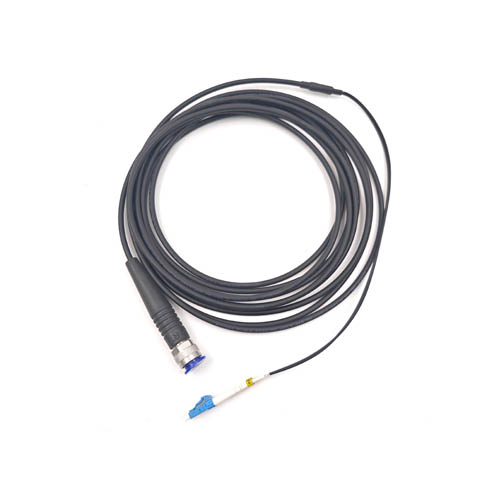
What makes an outdoor FTTA link a different procurement problem?
An FTTA link carries optical signals from a baseband or distribution point to radio equipment mounted outdoors, and every component in that path stays exposed to weather and mechanical load for the life of the site. That is why the assembly is specified as a service-life component rather than as a short jumper inside a rack.
FOCC's application data for this product class lists the working conditions directly: outdoor harsh environment, a wide temperature range from -40°C to +75°C, rain, dust, UV exposure, mechanical vibration and high tensile stress. Each condition points to a specific part of the assembly:
- Water and dust are handled at the interface, where a silicone rubber sealing ring and an IP67/IP68 rated connector body protect the ferrule end-face.
- UV and abrasion fall on the PE cable jacket, the outer barrier along the whole run.
- Tensile load and vibration are carried by an armored fiber core and a connector attachment rated to at least 1000 N.
- Corrosion is addressed in the connector shell; the ODC version uses a stainless steel shell, and the deployment record also cites corrosion-resistant plating.
- Optical stability depends on the zirconia ceramic ferrule and the APC end-face geometry that supports a ≥60 dB return loss.
A second difference is where the connector is made. A pre-terminated assembly moves polishing, splicing and connector assembly into a factory where every unit can be tested; on site, the technician mates a sealed connector instead of building one. FOCC describes FTTA assemblies as pre-terminated fiber optic jumpers engineered for tower-top deployment, which is consistent with this factory-terminated model.
Why tower-top, small cell and railway projects converge on one assembly standard
The three project types look unrelated, but they share an environmental envelope. FOCC's application record lists 5G base station RRU/AAU interconnection, FTTA, outdoor small cell deployment and railway signal transmission under one product family, together with 5G telecommunication, mobile network operators, industrial IoT, railway communication and public safety communication as target industries. Reference markets in the same record include the United States, Germany, Canada, Korea, the Netherlands, Saudi Arabia, the UAE and Russia — a list of addressed markets, not a statement of volume.
At architecture level, FOCC describes FTTA as an outdoor pre-terminated fiber-cable assembly solution for the link between baseband units and tower-mounted radio equipment, replacing heavy coaxial runs with optical links. Market context around that architecture points to expansion rather than a niche: Strategic Market Research values the global fiber optic cable assemblies market at USD 8.1 billion in 2024 and projects USD 14.2 billion by 2030. For import documentation, optical fibre cables are classified under HS code 8544.70.
The practical consequence for a buyer is SKU discipline. If one sealed assembly family covers the tower, the pole and the trackside cabinet, the differences between projects reduce to connector type, length and core count — and the acceptance procedure only has to be written once.
Which specification values answer most application questions?
The documented specification of the outdoor waterproof FTTA patch cord answers the majority of site questions before a drawing is exchanged. The table below restates the published values and adds what each one decides during selection.
| Parameter | Documented value | What it decides on site |
|---|---|---|
| Ingress protection | IP67 / IP68 | Whether the mated connector stays sealed under rain, wetting and dust; confirm the test condition behind the rating |
| Insertion loss | ≤0.30 dB | Optical margin left in the fronthaul link budget once the assembly is inserted |
| Return loss | ≥60 dB (APC) | Reflectance at the radio port; APC geometry is specified where 60 dB is required |
| Operating temperature | -40°C to +75°C | Continuous outdoor operation across cold starts and hot cabinet conditions |
| Tensile strength | ≥1000 N | Retention under installation pull and sustained mechanical load |
| Fiber type | OS2 single-mode; OM2/OM3/OM4/OM5 multimode | Matches the fiber to the reach and to the radio or signal interface |
| Construction | Zirconia ceramic ferrule; stainless steel ODC shell; PE jacket; armored core; silicone rubber sealing ring | Shows which part of the assembly absorbs which environmental stress |
IP67 and IP68 are both listed for this product family. Where a project requires IP68, request the corresponding test condition and product configuration in writing, because ingress claims can refer to different test setups.
Connector and model options
FOCC lists two outdoor waterproof configurations under this product name — ODC-APC-Fullax-APC-OS2 and ODC-UPC-Optitab-UPC-OM3 — described as the FTTA Outdoor Waterproof ODC-Fullax Patch Cord and the FTTA Outdoor Waterproof ODC-Optitab Patch Cord. The wider outdoor FTTA portfolio is reported to include FullAXS/NSN boot LC, ODC, ODVA and PDLC connector families, and one ODC-to-LC assembly is listed with single-mode 9/125 µm fiber in 2-core or 4-core versions. These are company-reported product listings; the interfaces on your radio unit and distribution box decide which of them applies.
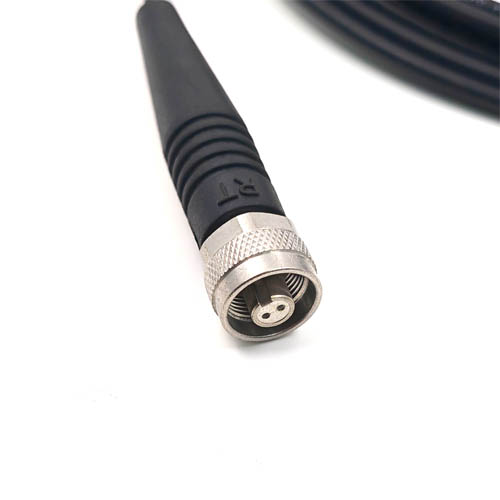
Step-by-step: how to specify and accept one outdoor patch cord run
The sequence below turns the headline values into a purchasable item and a verifiable shipment. It applies unchanged to a tower-top link, a small cell and a trackside cabinet.
- Draw the physical route and name both interfaces. Record the equipment at each end — baseband unit or optical distribution box on one side, RRU/AAU, small cell radio or signal equipment on the other — plus the measured cable length and whether the run enters through a cable gland or closure.
- Set the ingress class. Use IP67 as the entry point of the documented envelope and IP68 where sustained water exposure is a design condition; because both are listed for the same family, state on the purchase order which one is required.
- Write the optical acceptance values. ≤0.30 dB insertion loss and ≥60 dB return loss (APC) belong in the specification and in the incoming inspection record, with the measurement method agreed in advance.
- Write the mechanical requirement. ≥1000 N tensile strength, armored fiber core and PE jacket; for ODC versions, the stainless steel shell. State that the rating applies to the finished assembly, not to the bare cable.
- Configure the item. Length, connector type, core count, transmission mode, material, logo printing, certification documentation and packaging are listed as customizable, so the purchase order can describe the exact assembly rather than a product category.
- Agree the pre-shipment verification. Production runs with 100% testing, and third-party inspection, factory acceptance testing (FAT) and on-site acceptance can be written into the order as explicit checkpoints.
- Record the on-site acceptance result. Confirm that the assembly matches the approved drawing, inspect sealing surfaces and connector shells for transport damage, verify optical values by the agreed method, and log the serial numbers against the site.
Two of these steps are often skipped and both are inexpensive to add: naming the interface at each end, and stating the ingress class on the purchase order instead of accepting the rating printed in a brochure.
How the assembly fits three project types
5G tower-top RRU/AAU links
On a tower, the patch cord runs between the distribution point at the base or on the structure and the radio unit at the top. The mechanical load is continuous, the connector is mated once and then left in place, and any intervention requires tower access. That combination is why tensile rating, connector sealing and replacement speed matter more than a marginal difference in cable diameter. In FOCC's deployment record, tower-top RF unit interconnection is one of the documented applications.
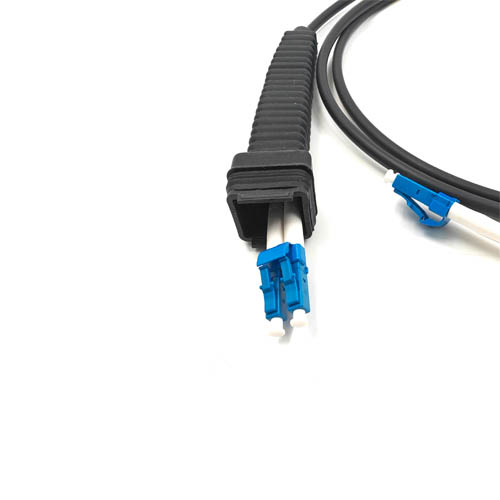
Outdoor small cell deployments
A small cell is mounted on a pole, wall or street furniture, so the run is shorter but the number of connectors in a small area is higher, and multi-sector sites often share a single route. Multi-fiber and fan-out assemblies — such as an outdoor waterproof ODVA(MPO) fan-out patch cord — are the configurations that reduce the number of separate runs, while the same IP67/IP68, temperature and tensile requirements continue to apply. The documented project type is outdoor small cell deployment.
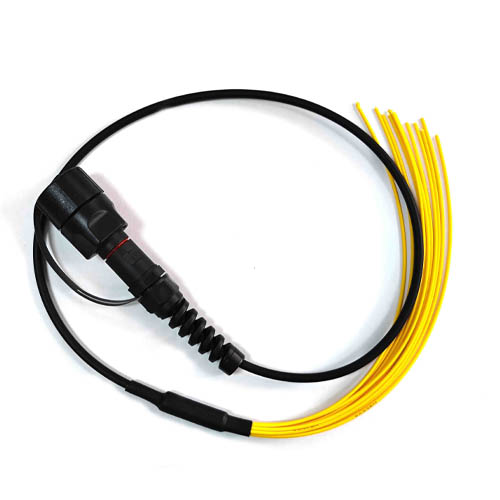
Railway signal transmission
Trackside installations add vibration and a maintenance calendar that follows track access rather than the operator's convenience. Connectors sit in cabinets and enclosures, cable routes are long, and dust plus temperature cycling are constant. The documented project type here is railway signal transmission, served from the same product family, with outdoor waterproof SC/APC and ODC assemblies covering the enclosure-to-equipment segment.
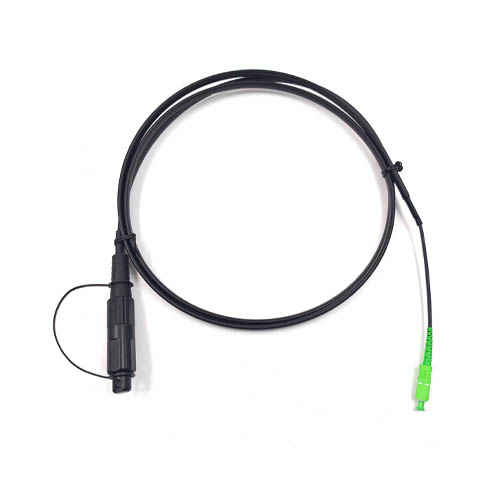
| Decision area | 5G tower-top RRU/AAU | Outdoor small cell | Railway signal transmission |
|---|---|---|---|
| Documented link function | 5G base station RRU/AAU interconnection | Outdoor small cell deployment | Railway signal transmission |
| Protection to specify | IP67 or IP68 | IP67 or IP68 | IP67 or IP68 |
| Temperature to specify | -40°C to +75°C | -40°C to +75°C | -40°C to +75°C |
| Tensile to specify | ≥1000 N | ≥1000 N | ≥1000 N |
| Connector emphasis | Sealed single or duplex interface at the radio port (ODC, FullAXS/NSN boot LC families) | Multi-fiber or fan-out configuration where sectors share a route | Enclosure-side SC/APC or ODC assemblies |
| Acceptance focus | Assembly-level loss and return loss before tower access | Connector cleanliness and sealing check during installation | Sealing and repeated mating in cabinet conditions |
The first four rows are documented product and application requirements. The connector and acceptance rows are selection guidance derived from those requirements; they are not a measured comparison between the three project types.
Replacement speed and lifecycle cost: what the deployment record shows
The case record behind this product covers a telecom carrier and 5G base station equipment vendor operating in Germany, Saudi Arabia and China, with 50,000+ outdoor waterproof patch cords installed across 20,000+ 5G base station deployments and more than ten years of IP68-rated service in harsh environments. The reported outcomes are an 80% lower field failure rate, on-site replacement in under ten minutes, and 40% lower operating expenditure (OPEX).
Those figures are company-reported results for that deployment and are worth reading as such: they describe what happened in one programme, not a guarantee for a different network. What transfers is the mechanism. A pre-terminated assembly with a sealed, plug-and-play connector turns the field task into a swap — disconnect, reseat, verify — rather than an on-site termination, and the sub-ten-minute replacement time in the record reflects that. On a tower the value sits in avoided tower access; in a trackside cabinet it sits in fitting the work into a short possession window.
Where a project wants the same mechanism, two clauses do most of the work: require that the assembly is factory-terminated and factory-tested, and define the replacement procedure and spare holdings in the maintenance plan.
Customization, MOQ and lead time
The commercial terms listed for this product family are short enough to quote in full. Production runs under OEM/ODM, with customizable length, connector type, core count, transmission mode, material, logo printing, certification documentation and packaging. The minimum order quantity is 2 units, lead time is 3–15 days, monthly capacity is 200,000 units, and quality control is 100% testing. The company profile adds an annual output of 2,000,000 units, ISO 9001 and ISO 14001 management systems, and remote after-sales support.
The low MOQ matters at the evaluation stage: a project team can order two assemblies in the final configuration, install them on a live site and take acceptance measurements before committing to a rollout quantity. The 3–15 day window is the production interval; transport and customs clearance to the destination market sit outside it.
FAQ: outdoor FTTA patch cords for tower, small cell and railway projects
1. What IP rating and temperature range should a tower-top or trackside FTTA patch cord meet?
Specify IP67 or IP68 together with continuous operation from -40°C to +75°C. Both ingress ratings and that temperature range are listed for FOCC's outdoor waterproof FTTA patch cord, and the outdoor requirement set in the application data adds UV resistance, corrosion resistance and anti-vibration. Because IP67 and IP68 both appear in the same family, state the required class on the purchase order and ask for the test condition behind it.
2. Which optical values belong in the acceptance criteria?
Write ≤0.30 dB insertion loss and ≥60 dB return loss on APC connectors into both the specification and the incoming inspection record. Those are the published limits for this product family; the APC end-face geometry is what supports the 60 dB return-loss figure, and the zirconia ceramic ferrule is the interface that has to hold it after repeated mating. Agree the measurement method and the pass/fail unit — per assembly, not per bare cable — before the first shipment.
3. Can one assembly family really cover tower-top, small cell and railway work?
Where site conditions fall inside the documented envelope, yes: the protection, temperature, tensile and optical requirements are identical, and what changes between projects is connector interface, length and core count. FOCC lists ODC-Fullax and ODC-Optitab assemblies under this product, reports a wider outdoor portfolio that includes FullAXS/NSN boot LC, ODC, ODVA and PDLC connectors, and lists single-mode ODC-to-LC assemblies in 2-core and 4-core versions. Confirm the interface at each end before ordering.
4. What does a ≥1000 N tensile rating actually protect?
It protects the optical path from mechanical load — the pull applied during installation and the sustained tension and vibration a mounted run sees afterwards. In this assembly the load is carried by an armored fiber core and a PE jacket, with a stainless steel shell on ODC versions. The rating is a product value: it states what the finished assembly is built to withstand, not what a specific installation will impose, so the route and fixing method still have to be engineered for the site.
5. How fast can a failed patch cord be replaced in the field?
Under ten minutes on site is the figure in FOCC's deployment record, and the mechanism behind it is the pre-terminated, plug-and-play connector: the technician disconnects the failed assembly, mates a spare and verifies the link, with no polishing or field termination. The same record reports an 80% lower field failure rate and 40% lower OPEX across 20,000+ 5G base station deployments and 50,000+ outdoor waterproof patch cords. These are company-reported results from one programme and should be validated through your own acceptance testing.
6. What drives the unit cost, and what is the minimum order?
Cost follows configuration rather than a single list figure: length, connector type, core count, transmission mode, material, logo printing, certification documentation and packaging are all customizable items, and each one changes the bill of materials. The minimum order quantity is 2 units, so a pilot order does not require a volume commitment. The supplied product data contains no list price, so pricing is quoted against the configuration and the destination market.
7. Can I evaluate a sample or a custom configuration before committing?
Yes. OEM/ODM production with a 2-unit minimum means a project can order the final configuration — connector type, length, core count and packaging included — and test it on site before a rollout order. Lead time for that order is 3–15 days, and every unit is tested before shipment.
8. What is the lead time, and how is the shipment verified?
Lead time is 3–15 days, with monthly capacity of 200,000 units behind it. Verification can be assembled from four checkpoints: 100% pre-shipment testing at the factory, third-party inspection, factory acceptance testing (FAT) against the agreed specification, and on-site acceptance after installation. A project that wants all four should name them on the purchase order, since they are agreed activities rather than defaults. Sample and quotation requests for a specific tower, small cell or railway configuration can be sent to FOCC Fiber Co.,Ltd through the contact details published on its website.
Conclusion
For tower-top, small cell and railway projects, the outdoor FTTA patch cord question resolves in a fixed order. The environmental envelope comes first — IP67/IP68, -40°C to +75°C, ≥1000 N — because those values decide whether the assembly belongs at the site at all. The optical limits follow — ≤0.30 dB insertion loss and ≥60 dB return loss on APC — because they decide whether the link budget closes. Only then do connector family, length, core count and commercial terms matter, and at that point the customization list, the 2-unit MOQ and the 3–15 day lead time make a pilot order practical. The final control is verification: 100% pre-shipment testing, third-party inspection, FAT and on-site acceptance, which convert a specification into evidence.
FOCC Fiber Co.,Ltd supplies these assemblies from a 5,000 m² factory in Guangzhou, with ODC-Fullax and ODC-Optitab outdoor configurations, OEM/ODM customization and 100% testing, and reports 50,000+ outdoor waterproof patch cords across 20,000+ 5G base station deployments.
Have Questions or Need More Details?
Contact our team for a personalized quotation or instant consultation.
Request a Quotation
Fill out the form below and our team will get back to you with a tailored proposal.
WhatsApp Direct Chat
Prefer to chat in real-time? Message us on WhatsApp for instant assistance & quick answers.
- Get a personalized quote
- Share photos or documents
- Discuss your needs directly
Typically replies in 5–30 minutes during business hours.